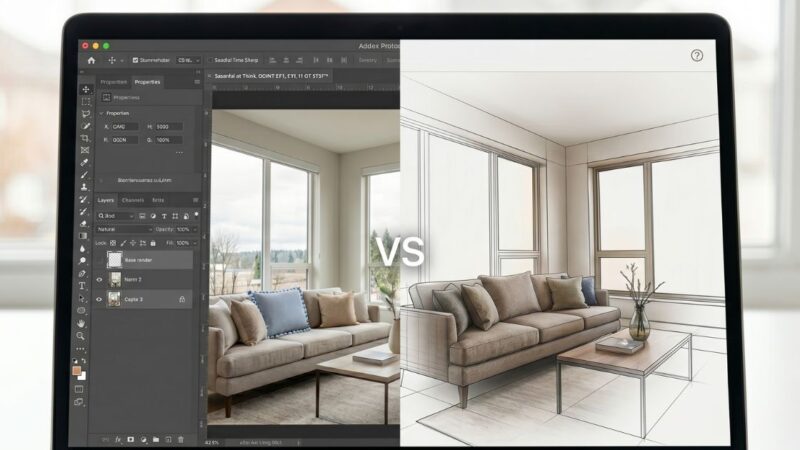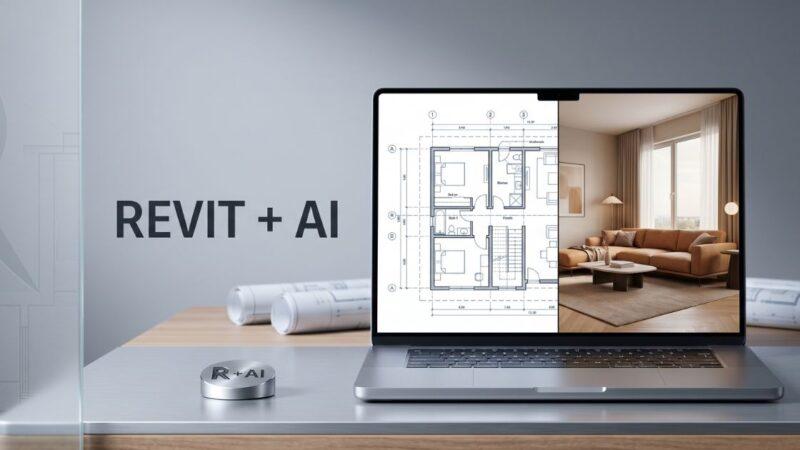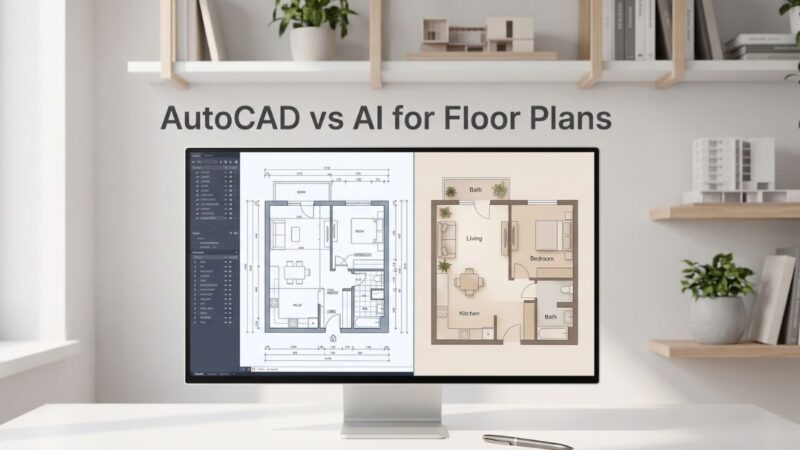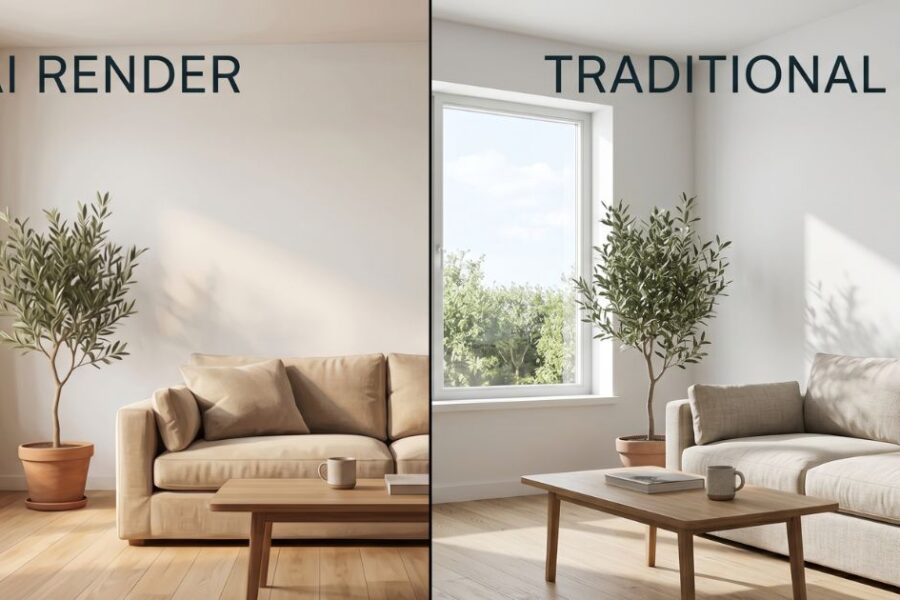
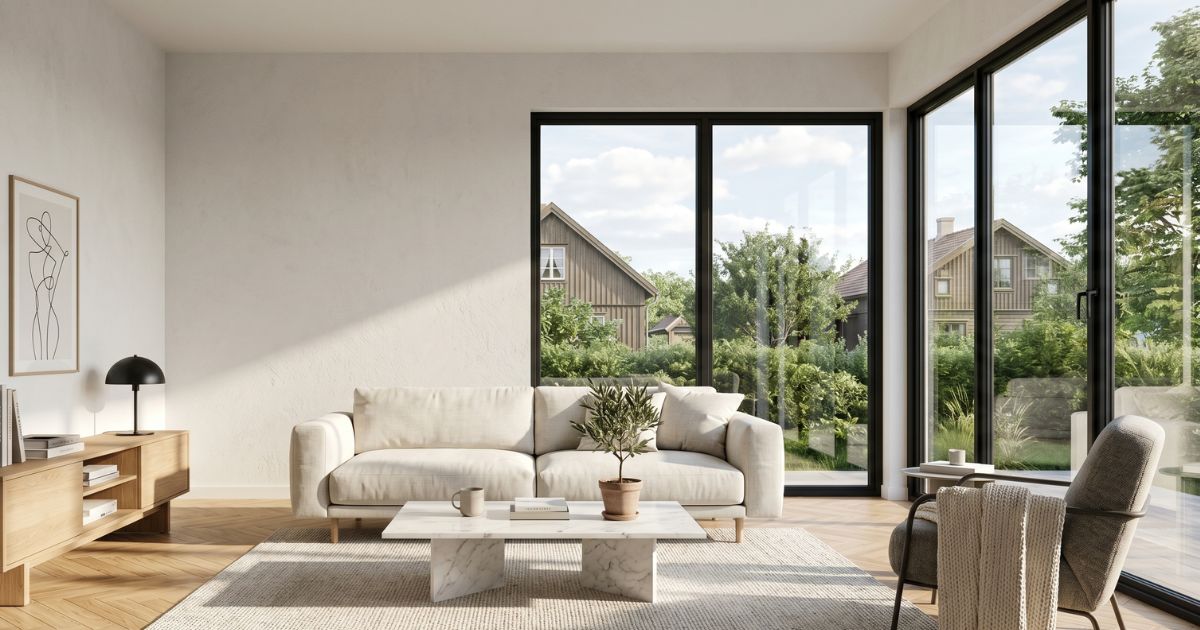
This is the working designer’s comparison between AI rendering and traditional 3D rendering — the cost, time, and quality differences in 2026, when each one wins, and how to integrate both into a professional rendering workflow.
Traditional 3D rendering — what it actually delivers
Traditional 3D rendering produces photoreal images from measured 3D models built in SketchUp, Revit, 3ds Max, or Blender. Output through engines like V-Ray, Corona, Enscape, Lumion, or Octane. Strengths:
- Geometric accuracy. Every dimension matches the underlying model exactly.
- Photoreal lighting. Physical light simulation with accurate shadows, reflections, and material behavior.
- Material specification accuracy. Real materials with measured properties.
- Print and publication quality. Final renderings suitable for editorial, marketing, and approval documents.
- Detailed control. Camera position, light source, time of day, weather — every variable specifiable.
Trade-offs: time-intensive. A single high-quality render takes 4–24 hours from model-ready state, including setup, lighting, materials, and rendering time. Multiple renders for one project can take days. Cost per render outsourced runs $200–$800 typically, $1,000–$3,000 for premium quality.
AI rendering — what it actually delivers
AI rendering produces photoreal interior images from photos, sketches, floor plans, or text prompts. Tools include Roomwork.ai (purpose-built for interior design), Midjourney (general-purpose), Stable Diffusion variants, and several specialized platforms. Strengths:
- Speed. Single rendering in 1–10 minutes from input. Variations near-instant.
- Photoreal output. Quality is now competitive with mid-tier traditional renders.
- Style fluency. Generating multiple design directions for the same space takes minutes.
- Existing-room rendering. AI can re-style an existing room from a photo, which traditional rendering cannot do without rebuilding the room as a model.
- Low marginal cost. Renders typically cost $0.10–$5 each on credit-based tools; subscription tools run $20–$200/month for unlimited or high-volume use.
Trade-offs: dimensional inaccuracy. AI renders are visually plausible but not measured. Trades and contractors cannot build from AI renders. Material specifications are visual approximations, not real product specifications.

Direct comparison
| Dimension | Traditional 3D | AI Rendering |
|---|---|---|
| Time per render | 4–24 hours | 1–10 minutes |
| Cost per render | $200–$800 typical | $0.10–$5 typical |
| Dimensional accuracy | Exact (matches model) | Visually plausible only |
| Material accuracy | Measured properties | Visual approximation |
| Iteration speed | Slow (full rebuild) | Near-instant variations |
| Existing-room rendering | Requires modeling first | Native from photo |
| Light simulation | Physically accurate | Visually convincing |
| Print/editorial quality | Excellent | Good and improving |
| Trade documentation use | Yes | No |
| Skill required | Months to master | Hours to days |
When AI rendering wins
- Concept-stage client presentations. Multiple direction options needed quickly.
- Proposal-stage visualization. Concept renders included in design proposals to lift close rates.
- Existing-room re-styling. Showing what an existing room could become without rebuilding it as a 3D model.
- Marketing content production. Variations of portfolio work for social media and website.
- Discovery-call visualization. Quick concepts during or immediately after the first client meeting.
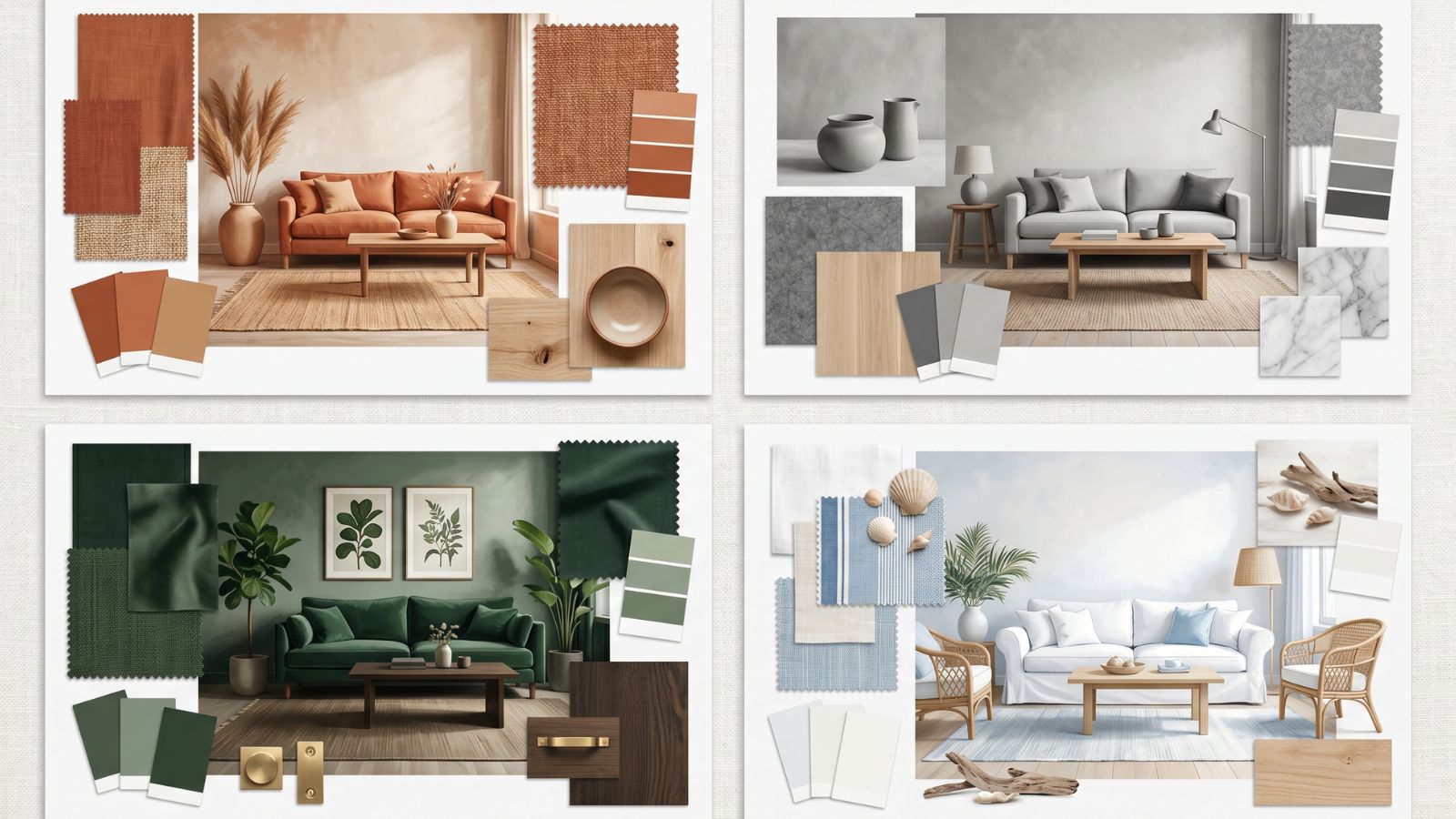
- Material direction studies. Comparing palette options in the same space.
- Lead generation content. Pinterest, Instagram, blog posts at production scale.
When traditional 3D rendering wins
- Final client approval images. Where dimensional accuracy matters for contract.
- Custom millwork and cabinetry. Where every dimension must be exact.
- Construction documents. Images used alongside drawings for trades.
- Editorial and publication. Architectural Digest, Elle Decor, Dwell still prefer traditional rendering quality for features.
- Award submissions. Most design awards still expect traditional rendering output.
- Hospitality and commercial pitches. Final pitches to hotel and commercial clients often require measured renders alongside concepts.
- Real estate developer pitches. Pre-sale unit renderings need geometric accuracy for marketing claims.
Cost comparison for a typical project
For a residential project with 8 rooms and 4 final renderings per room (32 total renderings), 2026 cost comparison:
| Approach | Time investment | Cost | Output quality |
|---|---|---|---|
| All traditional 3D | 120–200 hours | $8,000–$25,000 | Maximum |
| All AI rendering | 4–12 hours | $30–$300 | Concept-quality, dimensionally approximate |
| Hybrid (AI concept + traditional final) | 30–60 hours | $2,000–$6,000 | Concept-fast + final-quality |
The hybrid workflow captures most of the time and cost savings of AI while preserving documentation quality where it matters. This is the dominant working studio approach in 2026.
Frequently asked questions
Can AI rendering replace traditional 3D rendering?
Not entirely — they serve different purposes. AI rendering excels at concept-stage iteration, presentation work, and existing-room re-styling. Traditional 3D rendering remains necessary for dimensional accuracy, construction documentation, and final approval images. Most professional designers in 2026 use both in a hybrid workflow.
How much does an AI interior render cost in 2026?
AI interior renders typically cost $0.10–$5 each on credit-based tools, or $20–$200/month for subscription tools with unlimited or high-volume use. Compare with $200–$800 per traditional 3D render outsourced, or 4–24 hours of in-house rendering time.
Is AI rendering quality good enough for client presentations?
Yes, for concept-stage and proposal presentations in 2026. AI rendering quality has reached competitive levels with mid-tier traditional renders. For final approval images, editorial publication, and award submissions, traditional rendering quality is still preferred but the gap is narrowing.
Can clients tell the difference between AI and traditional 3D renders?
Most clients cannot reliably distinguish AI and traditional 3D renders for concept-stage work in 2026. Experienced designers and architects can sometimes identify AI work by characteristic limitations (slight dimensional inconsistencies, generic furniture). For final-stage work where dimensional accuracy matters, the differences become apparent.
Should I learn traditional 3D rendering if AI tools are improving?
Yes, for designers doing measured documentation, construction administration, or work that requires dimensional accuracy. Traditional 3D rendering remains the standard for documentation-quality output. AI tools have shifted where time investment goes in rendering workflows but haven’t replaced the underlying skill.
See it in your own projects.
Generate your first AI interior visualization in under 3 minutes. No 3D experience required.