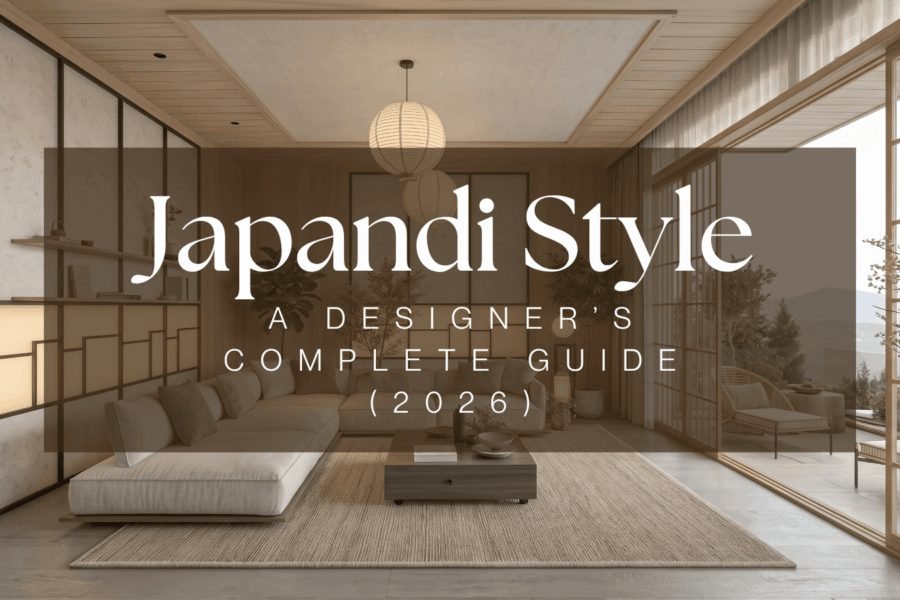
This is the complete designer’s reference for Japandi — defining principles, material palette, color rules, furniture vocabulary, room-by-room playbooks, and the prompting techniques that produce designer-grade Japandi AI renders.
What is Japandi style?
Japandi is a hybrid interior design style that combines two related minimalist traditions: Japanese wabi-sabi (beauty in imperfection, craft, aging) and Scandinavian hygge (warmth, functional comfort, lightness). It emerged as a distinct named style around 2018 and has been one of the most-requested residential aesthetics in the United States since 2022.
The style’s defining principle is restraint with warmth. It’s minimal but never cold. Calm but never sterile. Natural but never rustic. Dezeen has tracked Japandi’s rise in editorial coverage since 2020.
Defining elements of Japandi
| Element | Japanese contribution | Scandinavian contribution |
|---|---|---|
| Color palette | Warm whites, charcoal, clay, indigo | Soft grays, oat, oak natural, cream |
| Materials | Bamboo, washi paper, raku ceramic, charred wood | White oak, wool felt, linen, leather |
| Furniture profile | Low-profile, floor-anchored | Mid-height, functional, ergonomic |
| Negative space | Deliberate emptiness | Light, airy, restrained |
| Object philosophy | Craft, single-piece, irregular | Functional, well-made, durable |
| Lighting | Warm, diffused, paper-lantern | Layered, multiple temperatures |
Japandi color palettes
| Palette | Walls | Furniture / textile | Accent |
|---|---|---|---|
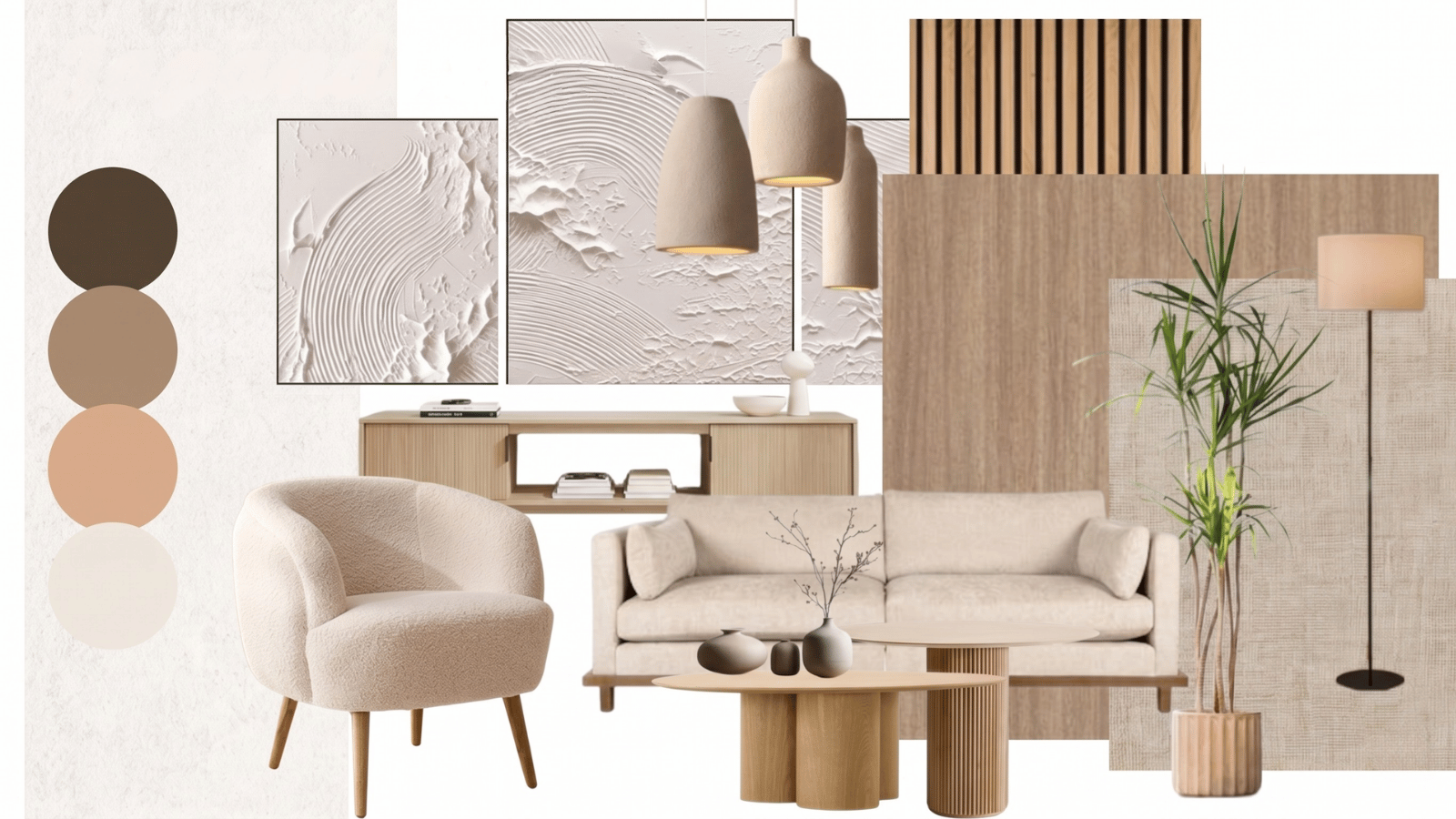
| Warm minimal | Clay, off-white | Oak natural, cream linen | Charcoal ceramic, charred wood |
| Calm contemporary | Soft gray, plaster | White oak, oat wool | Indigo textile, blackened steel |
| Earthy Japandi | Lime wash terracotta, taupe | Walnut, undyed linen | Raku ceramic, warm copper |
Japandi living room playbook
- Sofa. Low-profile, deep-seated, in oat or cream linen. Slipcovered for hygge softness; clean-lined for Japanese restraint.
- Coffee table. Solid wood (white oak or walnut), often a single live-edge slab on minimal base.
- Rug. Natural fiber (jute, sisal, wool). Patterned rugs fight the style.
- Lighting. Paper-lantern pendant; floor lamp with warm linen shade.
- Art / objects. One sculptural piece (raku ceramic, hand-thrown vessel) instead of a gallery wall.
- Plants. Single sculptural specimen — fiddle leaf fig, olive tree, or bonsai. Avoid clusters.
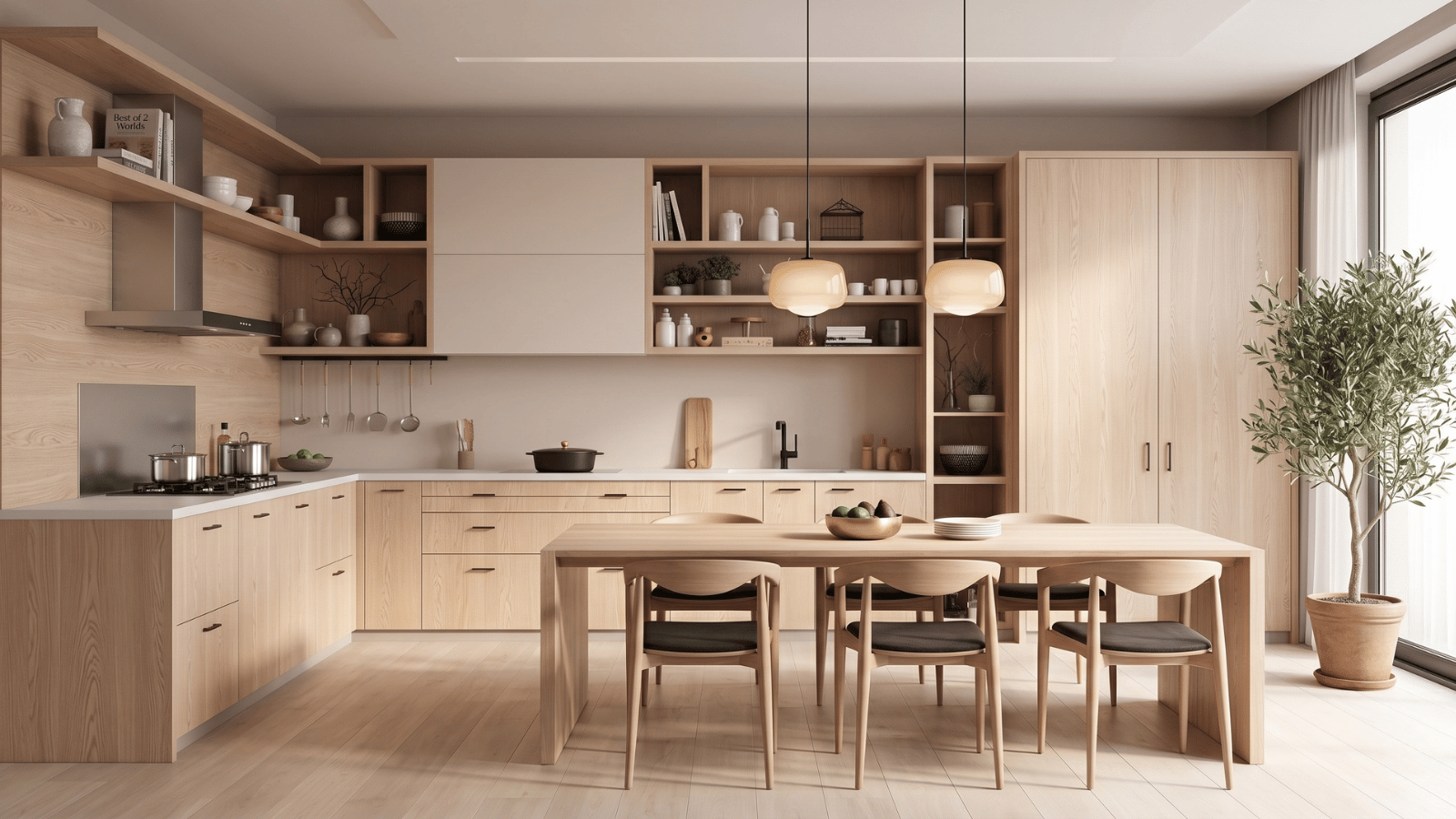
Japandi kitchen playbook
- Cabinetry. Slab-front (no shaker) in white oak natural, charred wood, or matte off-white. No upper cabinets where possible.
- Hardware. Push-to-open or recessed finger pulls. Avoid showy hardware.
- Countertops. Honed Calacatta or plaster-finish concrete.
- Backsplash. Single slab of stone (matching the counter) or zellige tile in warm white.
- Sink. Undermount stainless or fireclay. No farmhouse apron-front.
- Lighting. Single pendant over island; recessed elsewhere.
For visualizing Japandi kitchen directions before installation, AI tools handle the style well — see our AI kitchen design guide.
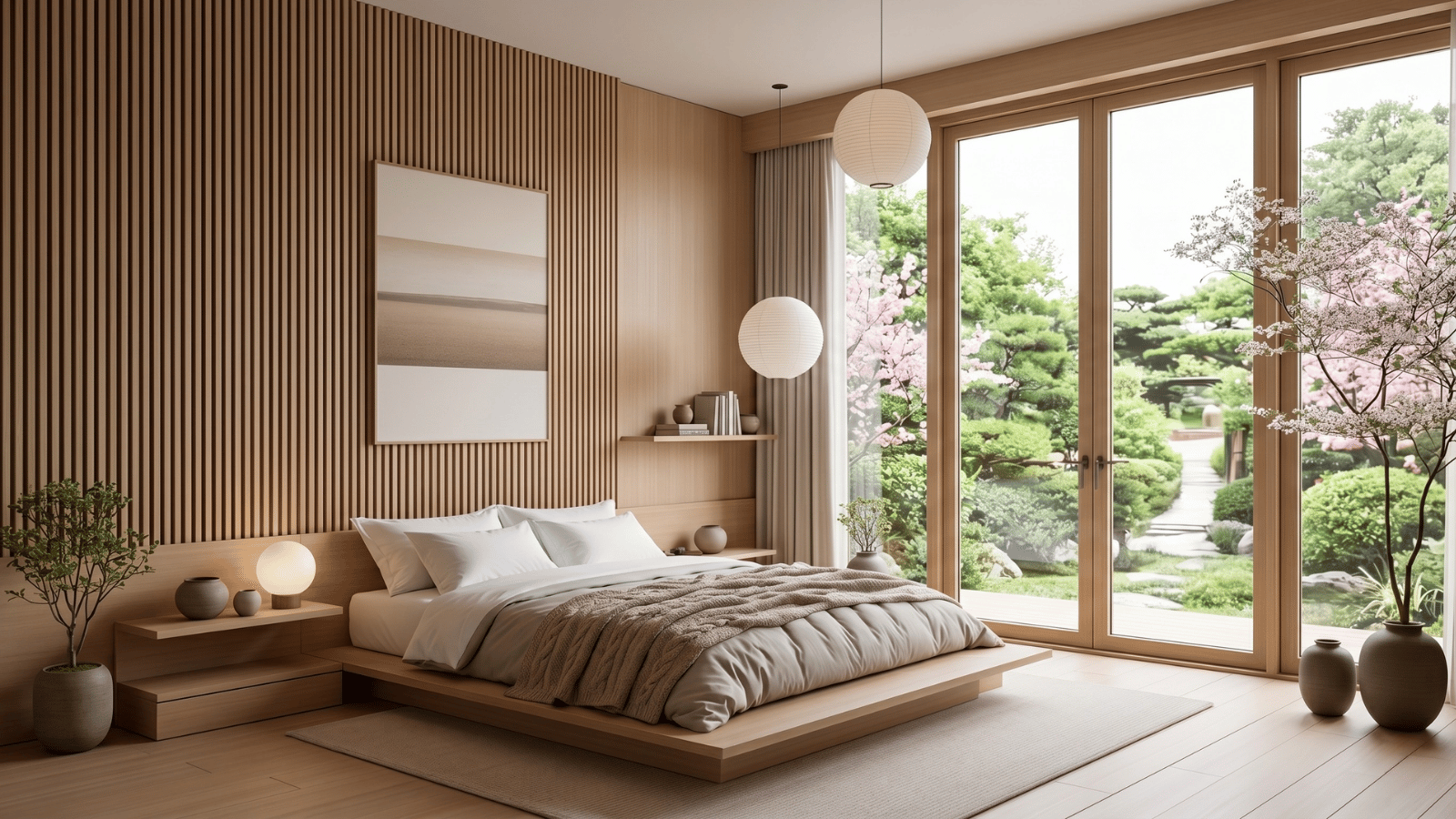
Japandi bedroom playbook
- Bed. Low-profile platform (Japanese influence). Walnut or white oak. Avoid tall headboards.
- Bedding. Washed linen in oat, cream, or warm white. Layer one wool throw in charcoal or rust.
- Nightstands. Small-footprint solid wood; a single ceramic vessel as styling.
- Walls. Plaster or lime wash; avoid feature wallpaper.
- Lighting. Paper sconces flanking the bed; warm bulb temperature throughout.
- Floor. Wide-plank natural oak; layer one tatami-style rug if appropriate.
See our AI bedroom design guide for visualizing Japandi bedroom directions.
Common Japandi design mistakes
- Over-styled “Japandi” decor. Wire baskets and mass-produced “Japanese-inspired” objects from big-box stores read as Pinterest cliché. Real Japandi sources hand-thrown ceramics, irregular textiles, real craft.
- Cool gray palette. Japandi runs warm. Cool grays drag the style toward generic minimalism.
- Too much black. One black accent is signature; black-on-black-on-black is moody contemporary, not Japandi.
- Cluttered surfaces. The whole point is negative space. One object beats five.
- Mass-market “Scandinavian” furniture as Japandi. IKEA Scandinavian functions but doesn’t carry Japandi’s craft layer.
Visualizing Japandi for clients with AI
- Anchor with one signature object. “Raku ceramic vessel on white oak shelf” steers the AI more precisely than the word “Japandi”.
- Specify wood species. “Rift-cut white oak” produces tighter grain; “American walnut” produces a darker, more dramatic Japandi.
- Lock the negative space. Add “minimal styling, deliberate negative space, single sculptural object” to push away from cluttered AI defaults.
- Control lighting. “Soft afternoon light, warm 2700K bulbs” produces hygge-warm Japandi; “morning overcast diffuse” produces cooler, more Japanese-leaning Japandi.
Roomwork.ai handles Japandi particularly well because the style’s restraint matches AI’s strengths. Try a room photo with three palette directions in a single session.
Frequently asked questions
What’s the difference between Japandi and minimalism?
Minimalism is about reduction; Japandi adds material warmth, craft objects, and natural textures. Japandi is warm minimal; pure minimalism can be cold.
What colors define Japandi style?
Warm whites, oat, cream, soft gray, clay, charcoal, indigo. Cool grays and pure whites fight the style.
What materials are essential to Japandi?
Solid wood (white oak or walnut), natural fibers (linen, wool, jute), hand-thrown ceramics, paper, plaster or lime wash walls.
Is Japandi style still popular in 2026?
Yes — it’s plateaued from the 2022 peak but remains one of the most-requested residential styles in the U.S. and Europe, especially for urban apartments and second homes.
Can Japandi work with existing furniture?
Yes if the existing pieces have clean profiles and natural materials. Mid-century modern furniture pairs particularly well.
How does AI help with Japandi visualization?
Japandi’s restraint matches AI’s strengths — fewer elements means cleaner output. Use AI to test material palettes and object placement before specifying.
See it in your own projects.
Generate your first AI interior visualization in under 3 minutes. No 3D experience required.