Maximalism is the rising counter-trend to a decade of restrained interiors. This guide covers how working designers specify maximalist projects well in 2026 — the organizing principles, the material strategy, the disciplined editing — and how AI tools fit a maximalist project workflow.
What maximalism actually is (vs. clutter)
Maximalism is not the absence of restraint — it’s the presence of abundance organized by strong design judgment. The distinction matters because the failure mode of maximalism (clutter, chaos, sensory overload) is so visible. Done well, maximalist interiors feel layered and personal; done poorly, they feel like an antiques warehouse.
Three principles separate maximalism that works from maximalism that fails:
- A strong organizing principle. A maximalist room needs one clear unifying idea — a color palette, a collected era, a textile language, a thematic narrative. Without an organizing principle, abundance becomes randomness.
- Disciplined repetition. Patterns repeat in different scales. Colors repeat in different objects. Eras repeat in different forms. The repetition is what creates coherence within abundance.
- Edited density. Every object earns its place. Maximalism is not about adding more; it’s about adding the right more.
The maximalist material palette
| Element | Specify | Avoid |
|---|---|---|
| Walls | Wallpaper, mural, deep saturated paint, paneling | White paint (defaults to minimalist) |
| Floors | Layered rugs, patterned carpet, geometric tile | Bare floors as default |
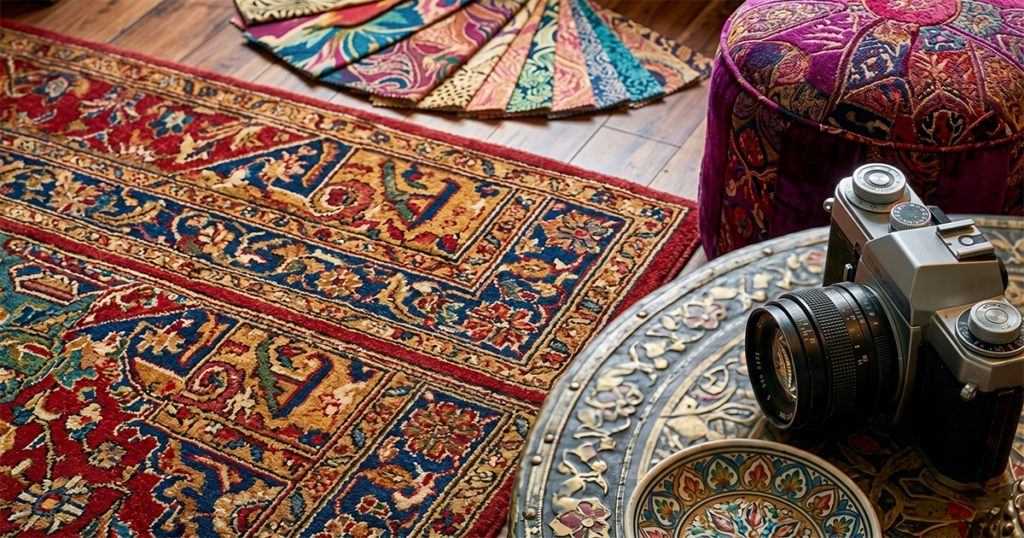
| Textiles | Velvet, silk, ikat, paisley, embroidery, jacquard | Plain linen, plain wool |
| Furniture | Mixed eras, sculptural shapes, statement pieces | Matching sets, single-era curation |
| Walls art | Salon-hung gallery walls, mirrors, plates, tapestries | Single statement piece per wall |
| Lighting | Chandeliers, sconces, multiple lamps, candles | Single ceiling fixture |
| Color | Saturated, layered, complementary, jewel tones | Monochromatic palettes |
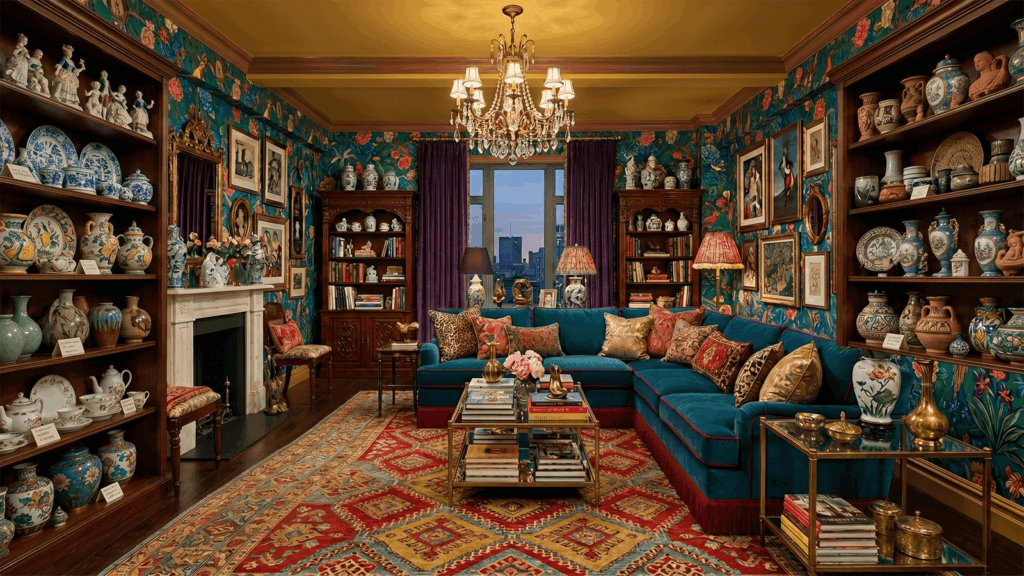
Five organizing principles that work
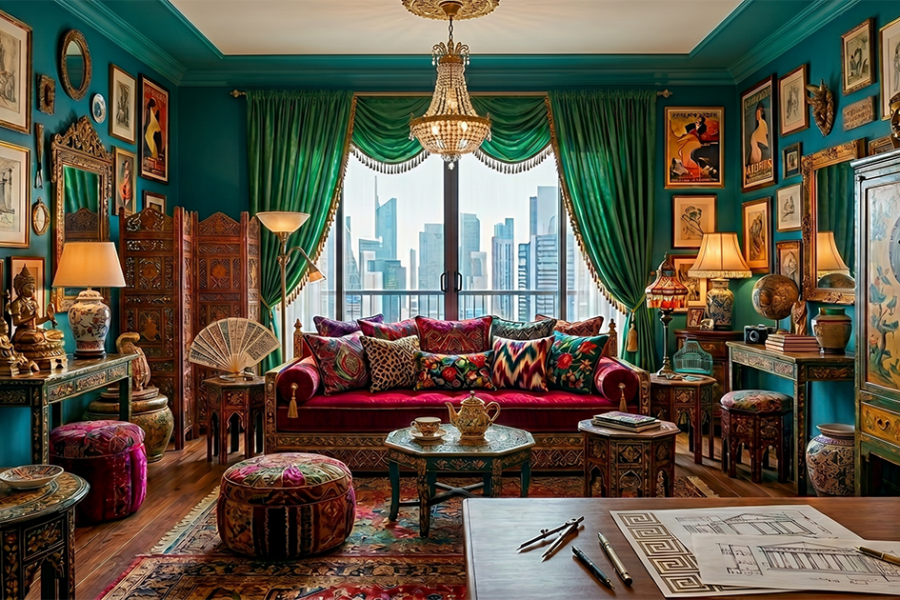
- A signature color. One color repeats across the room — emerald green walls, emerald velvet sofa, emerald glass lamps, emerald-embroidered cushions. Other colors swirl around the signature, but the green is the organizing logic.
- A collector’s narrative. The room reads as one collector’s life — Italian antiques, English ceramics, 19th-century art, vintage textiles. Disparate objects, unified by the implied collector.
- A geographic anchor. Moroccan riads, English country houses, Italian palazzos, Japanese ryokans — each is a maximalist tradition with internal coherence. Anchor to one and edit toward it.
- A thematic restraint. All florals, all animal patterns, all geometric prints, all stripes — the patterns vary in scale and color but share a thematic logic.
- An era curation. 1920s Hollywood, 1970s decadence, 1880s Aesthetic Movement — every era has its own maximalist language, and committing to one produces coherence.
The lighting strategy
Maximalist interiors live or die on lighting layering. The single biggest mistake is one overhead fixture and call it done. The working strategy:
- Multiple light sources at multiple heights. Chandelier overhead, sconces at picture rail height, table lamps at eye level, floor lamps in corners, candles on tables.
- Warm light throughout. 2700K or warmer. Cool light kills the romance maximalism depends on.
- Layered dimming. Each source on its own dimmer. The room should be tunable from “bright family dinner” to “intimate evening”.
- Visible bulbs and shades. Bulbs are part of the visual abundance, not hidden infrastructure.

How AI helps maximalist project work
Maximalist projects benefit specifically from AI because pattern and color combinations are difficult to evaluate from samples alone. Three key use cases:
- Pattern-mixing studies. Testing three different combinations of wallpaper + curtain + rug + upholstery patterns in the same room before committing. This is the single hardest skill in maximalist design, and AI lets you fail visually before failing in real life.
- Color saturation testing. Comparing the same room at three different color saturations — soft, medium, full — to find the right intensity for the client’s nerve.
- Gallery wall composition. Testing salon-hung gallery wall compositions before nailing them to the wall. Spacing, proportion, and visual weight are difficult to plan otherwise.
What AI doesn’t help with: sourcing the specific antiques, textiles, and curiosities that give maximalist rooms their soul. Real maximalism requires real vendor relationships, auction visits, and personal collecting — the human work that AI cannot do.
Frequently asked questions
Is maximalism the same as cluttered?
No. Maximalism is abundance organized by strong design judgment. Clutter is abundance without organization. The difference is the design discipline — a clear organizing principle, disciplined repetition, and edited density. Done well, maximalism feels layered and personal; done poorly, it feels chaotic.
How do I make a maximalist room feel cohesive?
Pick one organizing principle and edit toward it — a signature color, a collector’s narrative, a geographic anchor, a thematic restraint, or an era curation. Without an organizing principle, abundance becomes randomness. With one, every object reinforces the unified room.
Is maximalism back in 2026?
Yes, as a counter-trend to the cool, restrained interiors that dominated 2018–2024. The 2026 maximalist revival is more disciplined than the early-2010s eclectic phase — it favors strong organizing principles, saturated color, and intentional layering over hodge-podge eclecticism.
Can maximalism work in a small space?
Yes, and arguably better than in large spaces. Small maximalist rooms feel like jewel boxes — the abundance becomes immersive rather than overwhelming. Specify a strong saturated wall color, layered pattern in textiles, and dense gallery walls. Restraint is in the editing, not the quantity.
Is maximalism the opposite of minimalism?
Yes and no. They’re opposite in surface aesthetics (abundance vs. restraint) but share the underlying discipline of intentional curation. The best minimalist rooms and the best maximalist rooms are both deeply edited — minimalism edits down to fewer perfect things, maximalism edits up to more perfect things.
See it in your own projects.
Generate your first AI interior visualization in under 3 minutes. No 3D experience required.