This is a working library of 50+ prompts and prompt formulas, tested across Midjourney, ChatGPT, Roomwork.ai, and the major generative tools in 2026. Each example is structured the way professional designers actually use them — copy them directly, adapt the variables, ship faster.
Why prompts matter for interior designers
The single biggest variable between a designer who ships great AI work and one whose outputs look generic is prompt quality. A vague prompt produces vague results — busy compositions, wrong material logic, awkward lighting. A structured prompt produces images that pass for finished mid-stage renders.
The pattern that consistently produces professional outputs follows five elements: subject (what the room is), style (the design language), materials (specific finishes by name), lighting (mood and source), and camera (focal length and angle). Skip any one of these and the AI fills in the gap with averages from training data, which is why so many AI interiors look like the same render.
The 5-part prompt formula for interior design
Use this formula as the base for any AI interior render. Fill in each slot with specifics — the more concrete, the more controlled the output.
| Slot | Generic (avoid) | Specific (use) |
|---|---|---|
| Subject | “kitchen” | “galley kitchen with 12-foot island” |
| Style | “modern” | “warm contemporary, soft Japandi influence” |
| Materials | “wood and stone” | “rift-sawn white oak, honed Calacatta marble, brushed brass” |
| Lighting | “natural light” | “morning side light from east window, warm 2700K pendants” |
| Camera | “wide shot” | “35mm, eye-level, slight three-quarter angle” |
The complete prompt becomes: “Galley kitchen with 12-foot island, warm contemporary with soft Japandi influence, rift-sawn white oak cabinetry, honed Calacatta marble counters, brushed brass hardware, morning side light from east window, warm 2700K pendants, 35mm eye-level photograph, three-quarter angle, editorial interior photography style.”
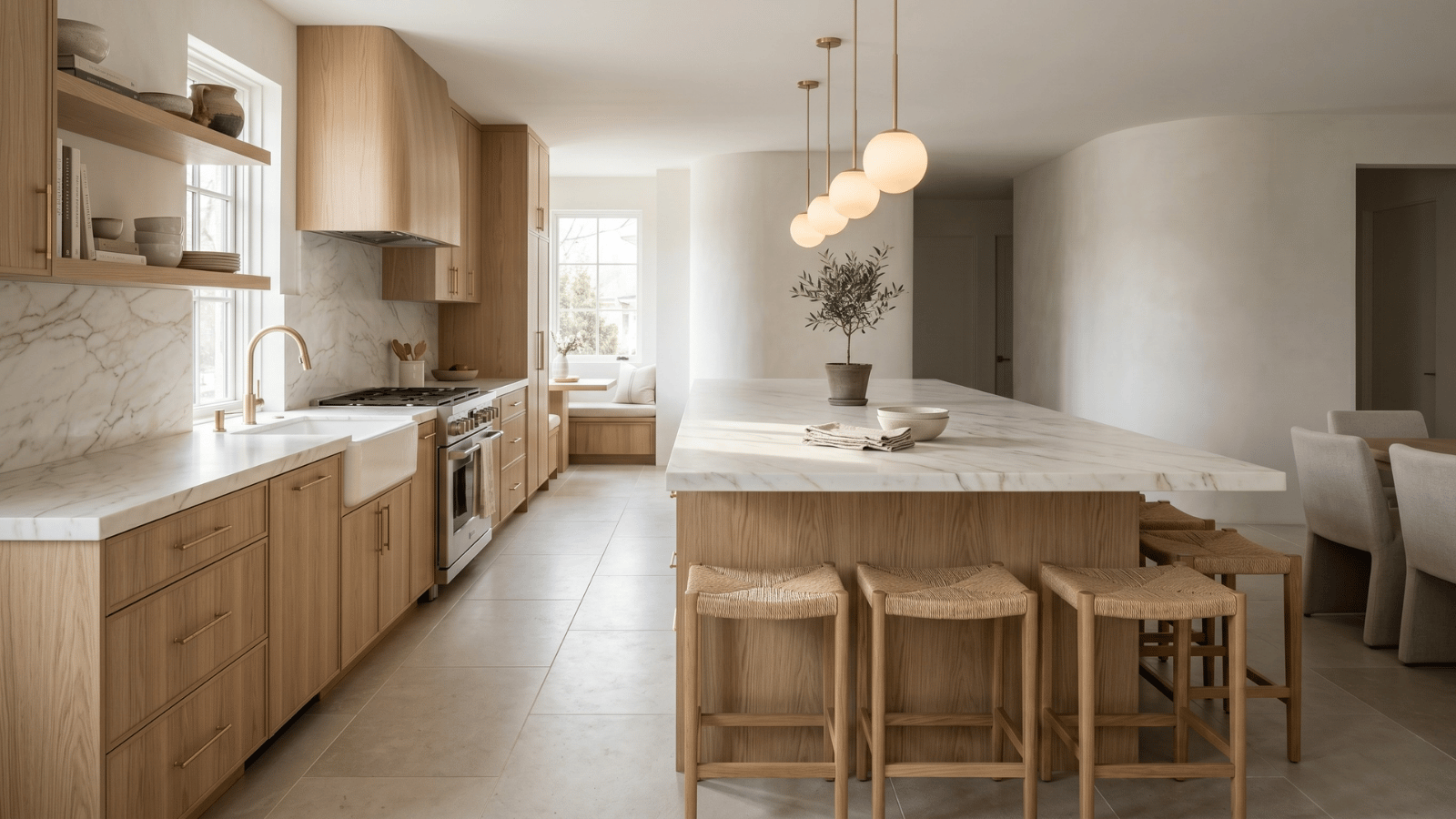
20 kitchen design prompts
Each of these is a complete prompt — copy, adapt the materials and dimensions, generate. Tested in Midjourney v6 and Roomwork.ai.
- Warm modern kitchen, rift-sawn white oak slab cabinetry, honed Carrara marble waterfall island, brushed nickel hardware, integrated paneled refrigeration, morning daylight, 35mm editorial photography.
- Moody English country kitchen, dark green Shaker cabinetry, unlacquered brass, soapstone counters, copper range hood, warm tungsten pendants, evening light, film grain.
- Japandi galley kitchen, light ash wood, plaster walls, integrated sink, paper pendant lighting, low contrast, soft diffuse north light.
- Mediterranean villa kitchen, lime-washed walls, terracotta floors, walnut beams, vintage Spanish tiles, copper accents, golden hour light.
- Scandinavian minimalist kitchen, white oak, soapstone, black faucets, plaster hood, north window, overcast diffuse light.
- 1970s revival kitchen, walnut paneling, burnt orange tile backsplash, chrome fixtures, smoked glass pendants, warm afternoon light.
- Pacific Northwest cabin kitchen, blackened steel, reclaimed Douglas fir, soapstone, exposed beams, woodstove, golden window light.
- French apartment kitchen, white cabinetry, herringbone parquet floor, antique chandelier, marble counters, tall casement windows.
- Brutalist concrete kitchen, board-formed concrete island, blackened steel cabinetry, integrated lighting, single pendant, dramatic side light.
- Coastal modern kitchen, white shaker, blue island, brass pulls, marble counters, Roman shades, sunlit afternoon.
- Italian villa kitchen, exposed brick arches, polished plaster, marble counters, walnut island, candlelit pendants, evening warmth.
- Bauhaus-inspired kitchen, primary color accents, white cabinetry, chrome detailing, terrazzo floor, single statement light.
- Eclectic bohemian kitchen, mixed cabinet finishes, patterned tile backsplash, woven pendants, plants, soft diffused light.
- Art Deco revival kitchen, fluted oak cabinetry, black marble, polished brass, geometric tile floor, warm pendants.
- Industrial loft kitchen, blackened steel, exposed brick, concrete counters, factory pendants, tall casement windows.
- Mountain modern kitchen, blackened steel, walnut, soapstone, exposed beams, fireplace, late winter afternoon light.
- Greek island kitchen, whitewashed plaster, weathered wood, blue accents, open shelving, harsh midday sun.
- Mid-century modern kitchen, walnut cabinetry, white quartz, brass hardware, sputnik pendant, terrazzo floor, warm light.
- Tropical modernist kitchen, teak cabinetry, breeze blocks, polished concrete floor, vintage rattan stools, ceiling fan, golden light.
- Provence farmhouse kitchen, painted cabinetry, copper pots, lavender bouquet, terracotta floor, French doors open to garden.
10 living room prompts
Living rooms are where lighting and material logic show up most. These prompts emphasize specific furniture lines and natural light direction.
- Warm contemporary living room, low slung Italian leather sofa, travertine coffee table, plaster walls, oversized vintage rug, warm afternoon light through linen drapes.
- English country library, paneled walls in deep green, antique leather chairs, brass library lamp, woven rug, fireplace lit, evening warmth.
- Japandi living room, low platform sofa in natural linen, paper lantern lighting, ash floors, single ceramic on plaster wall, soft diffuse light.
- 1970s revival living room, conversation pit, burnt orange and chocolate brown velvet, walnut paneling, chrome arc lamp, warm tungsten light.
- Coastal modern living room, slipcovered sofa, sisal rug, white plaster fireplace, weathered wood beams, ocean view through tall windows.
- Brutalist concrete living room, board-formed concrete walls, low leather sofa, single sculptural pendant, single mature olive tree, dramatic side light.
- Parisian apartment living room, herringbone parquet, white boiserie, vintage Chesterfield, antique chandelier, tall casement windows, soft morning light.
- Maximalist living room, layered patterns on walls and floor, deep velvet sofa, gallery wall, brass accents, multiple light sources, evening mood.
- Mountain modern living room, blackened steel fireplace, walnut paneling, oversized leather sofa, sheepskin throws, mountain view, golden hour light.
- Mid-century modern living room, low walnut credenza, Eames lounge, sputnik chandelier, jute rug, walnut floors, warm afternoon side light.

10 bedroom prompts
Bedroom prompts emphasize textile, soft lighting, and intimacy. Specify bedding detail and headboard material specifically.
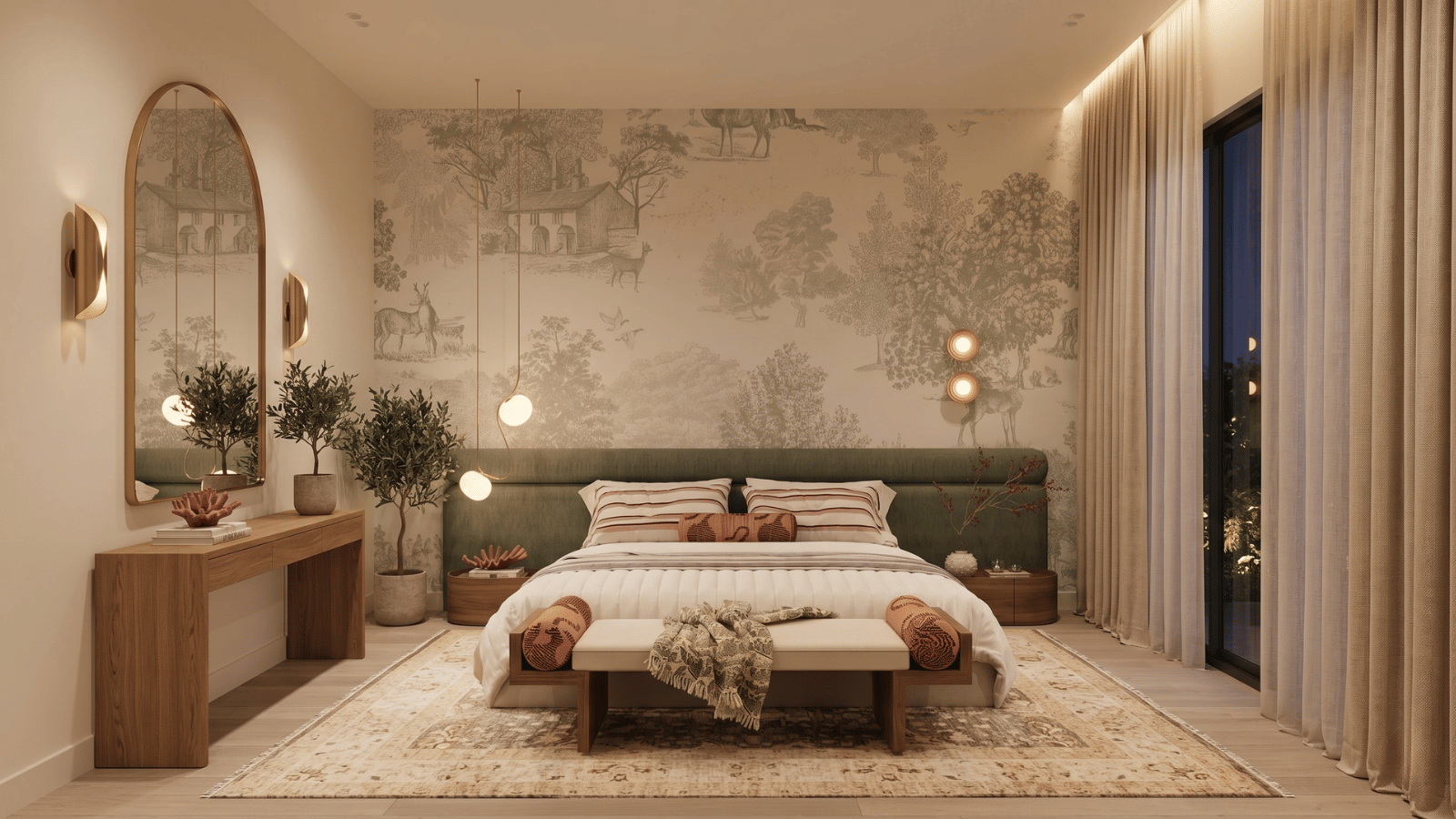
- Warm contemporary primary bedroom, low upholstered linen bed, layered cream bedding, walnut nightstands, brass sconces, plaster walls, dawn light through sheer linen drapes.
- English country bedroom, four-poster bed in deep blue, floral wallpaper, antique writing desk, brass lamps, fireplace, evening light.
- Japandi bedroom, low platform bed in light wood, single ceramic on plaster wall, paper lantern, ash floors, north-facing diffuse light.
- Parisian apartment bedroom, antique iron bed, white boiserie, herringbone parquet, vintage rug, crystal chandelier, soft morning light through tall windows.
- Coastal modern bedroom, white linen bedding, weathered wood headboard, sisal rug, plaster walls, ocean breeze, afternoon light.
- 1970s revival bedroom, brown velvet headboard, burnt orange bedding, smoked glass nightstand lamps, mirrored closet doors, warm evening light.
- Brutalist bedroom, concrete headboard wall, low platform bed, single pendant, single artwork, gray linen bedding, dramatic side light.
- Mountain modern bedroom, blackened steel bed frame, walnut floors, sheepskin throws, fireplace, mountain view through window, golden hour.
- Mid-century modern bedroom, walnut platform bed, Eames-era nightstands, jute rug, white linen bedding, brass pendant, warm afternoon light.
- Maximalist bedroom, layered patterned wallpaper, velvet bed, gallery wall, brass sconces, multiple soft light sources, evening warmth.
Prompts for mood boards and material studies
For mood board work, prompts shift from “render a room” to “produce a curated grid of references”. The technique: ask for a flat-lay or grid composition specifically.
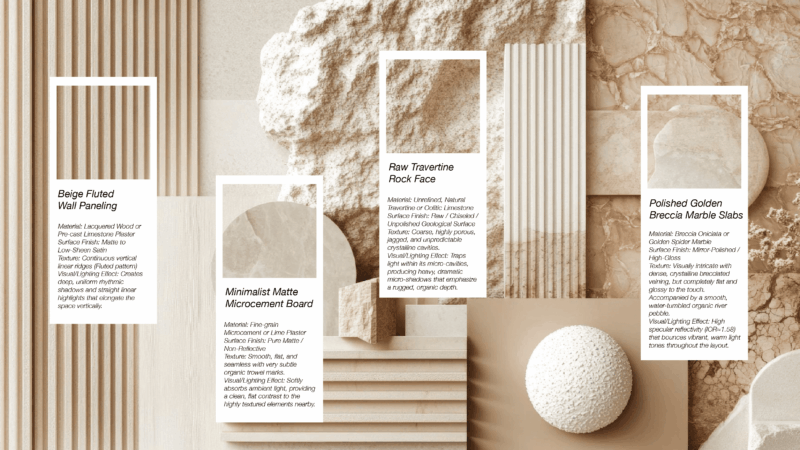
- Curated material flat-lay for warm contemporary kitchen, rift-sawn white oak veneer, honed Calacatta marble sample, brushed brass hardware, ivory linen swatch, top-down photography, soft natural light.
- Mood board grid for English country bath, six images: claw-foot tub, brass fixtures, marble herringbone floor, dark green millwork, antique mirror, sconces, top-down arrangement.
- Texture study grid, polished plaster wall, oak end grain, raw silk, hammered copper, woven seagrass, natural travertine — six samples, top-down, north light.
- Color palette study for Mediterranean kitchen, terracotta orange, lime-washed white, olive green, weathered walnut, burnished copper — paint chip grid, neutral background.
- Curated reference grid for Japandi living room, low platform sofa, paper lantern, ceramic vessel, ash wood floor sample, plaster wall texture — six images, calm composition.
Five rules for prompts that ship
- Specify materials by name, not adjective. “Calacatta Gold marble” beats “white marble”. The model has learned the actual material’s visual signature.
- Use designer-language descriptors. “Rift-sawn”, “honed”, “shou sugi ban”, “lime-washed” — these are tagged in training data with the correct visual outputs.
- Always specify lighting source and time of day. “Morning side light from east window” produces dramatically more controlled results than “natural light”.
- Lock the camera. Add “35mm, eye-level, three-quarter angle” or similar at the end. Without it, the model picks a random focal length.
- Add a photographic reference style. “Editorial interior photography style”, “AD magazine style”, “Architectural Digest spread” produces sharper, more professional outputs than rendering language.
Frequently asked questions
Do these prompts work in Midjourney, Roomwork, and ChatGPT?
The five-part formula transfers across all major generative AI tools. Each tool weights the slots slightly differently — Midjourney responds strongly to photographic style cues, Roomwork.ai weights material specificity, ChatGPT’s image generation responds to camera and lighting detail. Test the same prompt across two tools and pick whichever output is closer to your goal.
How long should an AI interior design prompt be?
Between 30 and 80 words is the sweet spot for most tools. Below 30 words, the model fills gaps with averages. Above 80 words, conflicting instructions reduce coherence. Hit all five slots — subject, style, materials, lighting, camera — and stop.
Should I use negative prompts?
Yes, for Midjourney specifically. Common negative prompts that improve interior work: –no clutter, –no people, –no text, –no watermark. For Roomwork.ai and most other tools, the negative prompt syntax differs — check the documentation for your tool.
How do I get consistent results across multiple rooms in one project?
Lock a ‘house style’ prompt fragment — typically the style, materials, and lighting slots — and only change the subject. So ‘galley kitchen’ becomes ‘primary bedroom’, but the rest of the prompt remains identical. This produces a visually coherent series of renders for the same project.
Why do my AI renders look generic even with detailed prompts?
Three usual culprits: vague material descriptors (‘wood’ instead of ‘rift-sawn white oak’), missing lighting source (‘natural light’ instead of ‘morning east window light’), and missing camera direction. Specifying these three lifts most prompts from generic to professional immediately.
See it in your own projects.
Generate your first AI interior visualization in under 3 minutes. No 3D experience required.