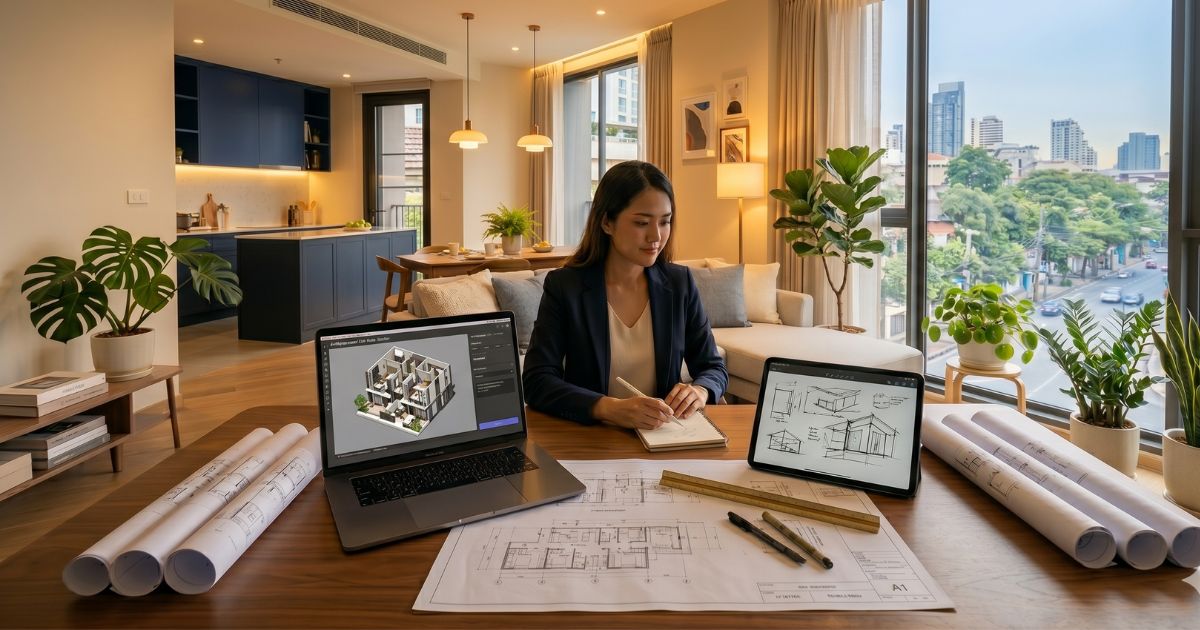
This is the multifamily developer’s and interior designer’s guide to AI-accelerated unit design — why multifamily benefits more from AI than nearly any other vertical, the specific workflow that’s working in 2026, and the pricing and timeline impact developers can expect.
Why multifamily is uniquely AI-fit
Multifamily and apartment development has three economic characteristics that make AI integration unusually high-leverage:
- Unit repetition. A 200-unit development typically has 4–8 unit types repeated across the building. Design decisions made for each unit type apply to 25–50 units. The leverage on each decision is enormous.
- Pre-sale and pre-lease visualization need. Multifamily projects sell or lease before completion. Visualization quality directly affects sales velocity and pricing.
- Tight margins, fast cycle times. Multifamily projects run on disciplined budgets and timelines. Compressing design iteration by 60–80% has direct project-economic impact.
The vertical has lagged in interior design sophistication historically because budgets were thin and direction was often “developer-grade neutral” — beige, generic, safe. AI changes the calculus because exploring better direction now costs days instead of weeks.
The 2026 multifamily AI workflow
- Unit type matrix. Identify the 4–8 unit types (studio, 1BR, 2BR, 2BR+den, etc.) and the rooms in each.
- Direction exploration in AI. Generate 4–6 interior direction options for the largest unit type (typically the 2BR). 4–8 hours of focused AI work produces 20–40 high-quality visualizations across direction options.
- Developer and marketing review. Sales/marketing team picks 1–2 strongest directions based on target tenant profile and competitive positioning.
- Apply direction to all unit types. Generate AI visualizations of the chosen direction across all 4–8 unit types. 8–16 additional hours of AI work.
- Marketing render production. 3–5 final marketing renderings per unit type for the leasing/sales website and brochure. Refined in Photoshop.
- Conventional documentation. Architectural documentation, FF&E specification, and trade coordination proceed in CAD/Revit through normal channels.
Total AI work: 30–60 hours for a full 200-unit development. Compare with 80–160 hours of equivalent traditional visualization. The savings free up budget for higher-quality renderings (volume × quality tradeoff favors AI).
Where AI lifts pre-sale and pre-lease conversion
The single highest-revenue impact of AI in multifamily is on pre-sale and pre-lease conversion. Three specific mechanisms:
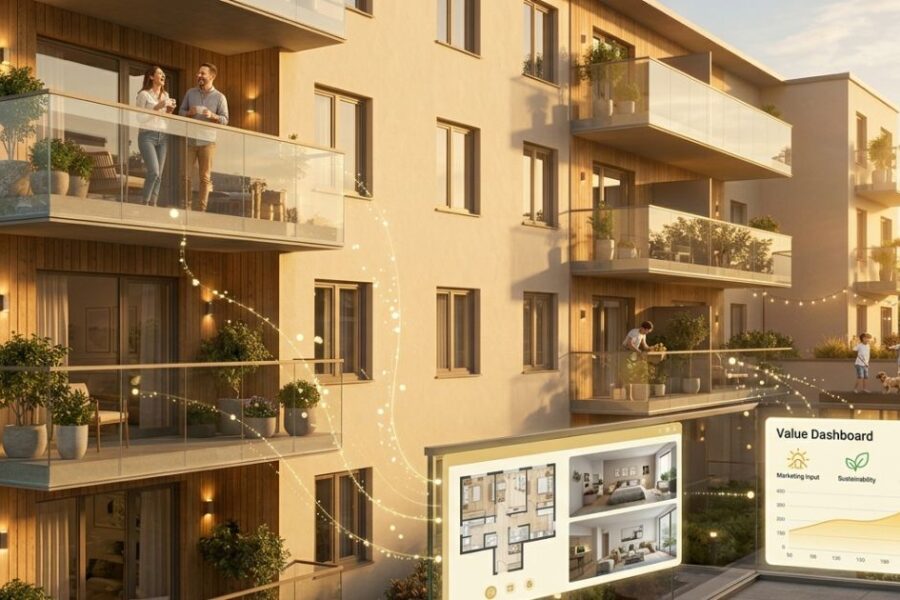
- Higher-quality unit visualizations. Prospects who can see what the unit looks like — beyond the floor plan — convert at meaningfully higher rates. AI lets developers afford photoreal renderings for every unit type, not just the model unit.
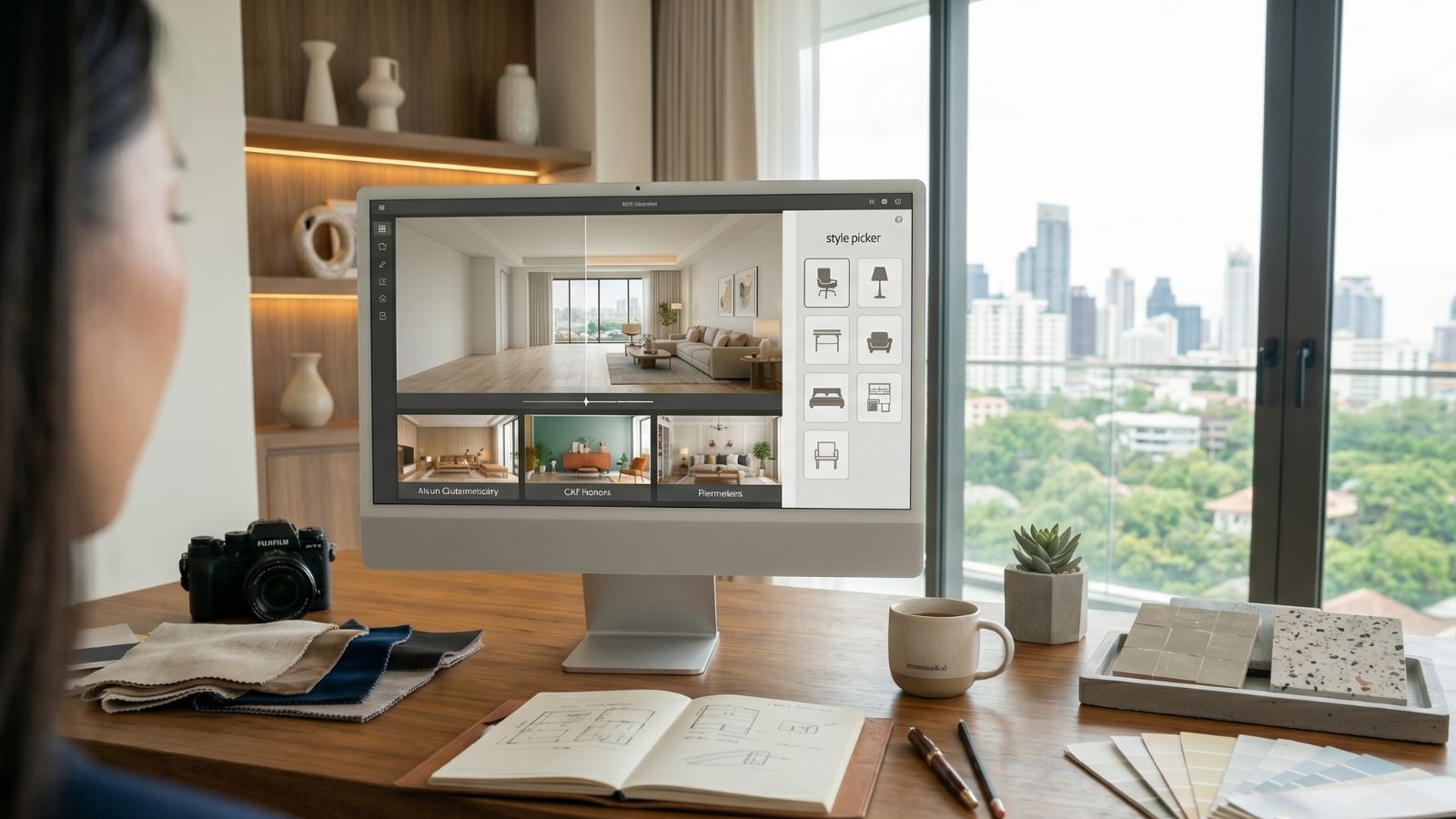
- Style variation visualization. Showing prospects the unit in 2–3 design directions (warm contemporary, mid-century, transitional) lets the developer test which direction resonates with the target demographic.
- Furnished vs. unfurnished comparison. AI virtual staging lets developers present units both ways — empty for prospects who want to imagine, furnished for prospects who need to see.
Developers who have adopted AI-rendered unit marketing typically report 15–30% lift in pre-lease conversion and 20–40% lift in pre-sale conversion compared to floor-plan-and-photo marketing.
Specifying multifamily interiors that age well
- Real materials within budget. Real wood floors (engineered, not laminate) when budget allows; quality LVT when not. Lime-washed plaster or quality paint, not vinyl wall covering.
- Quality fixtures over quantity. One statement decorative pendant beats five recessed cans in the same budget.
- Neutral foundations, layered character. Foundation finishes (floor, cabinets, counters) in warm neutrals that don’t date; character in lighting, hardware, art, and textiles that can be updated by the tenant or developer at lease turn.
- Consistent palette across unit types. Developments that maintain palette consistency across unit types read as designed. Mixed palettes read as cheap.
- Premium common areas, restrained units. Multifamily that overspends on units and underspends on common areas underperforms. The amenity floor and lobby drive leasing decisions; unit interiors confirm them.
How the developer-designer relationship has evolved
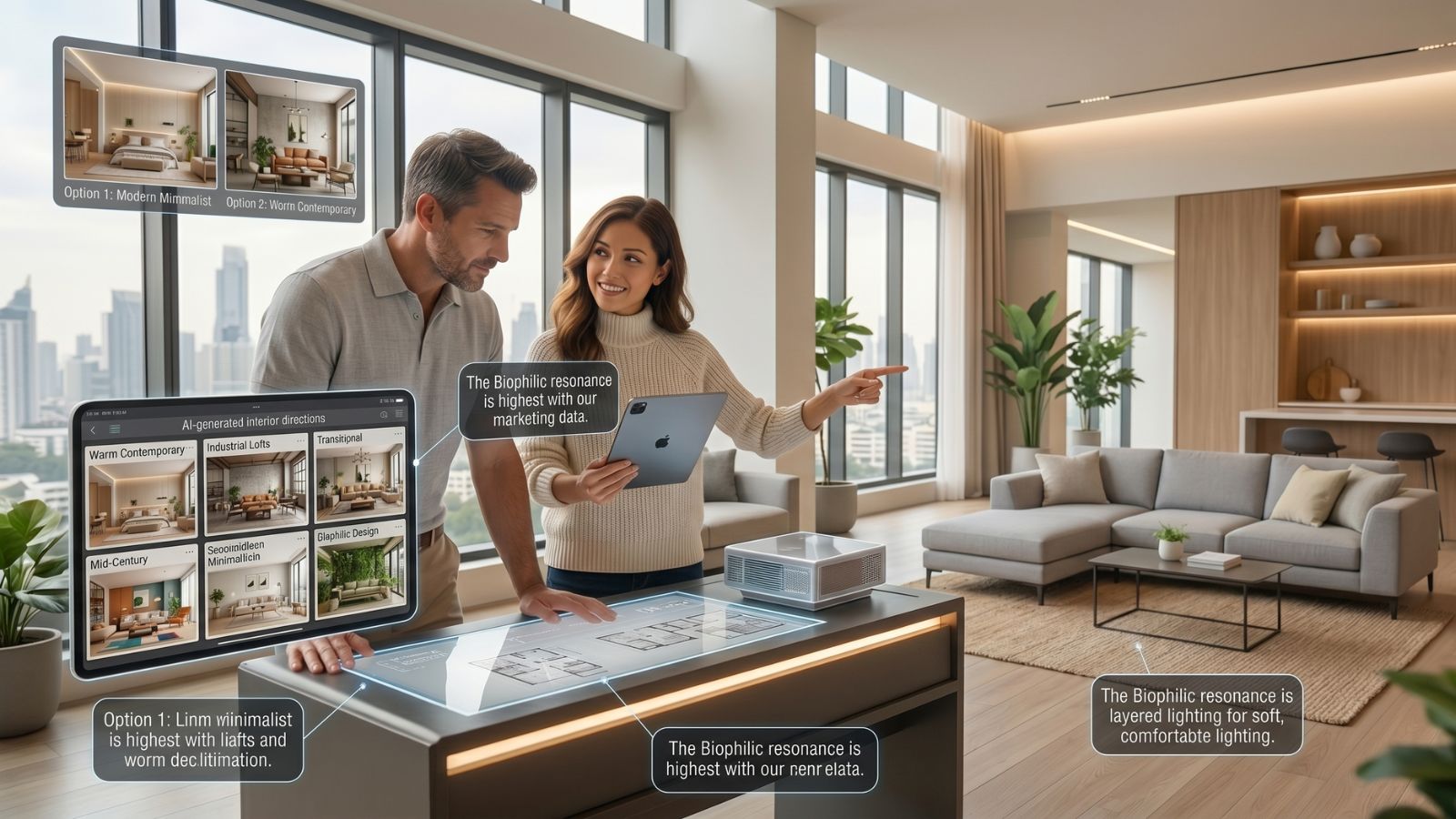
Pre-2024 multifamily design typically had a thin developer-designer relationship: developer briefed designer, designer produced one direction, developer either accepted or asked for changes that took weeks each. AI has changed this dynamic. The 2026 developer-designer pattern:
- Rapid concept exploration in the first 2 weeks. Designer presents 5–8 AI-rendered directions across unit types early.
- Developer participates in direction selection. Sales/marketing input drives the selection. The direction is collaboratively narrowed.
- Iteration cycles compressed from weeks to days. Developer feedback in week 2 produces revised AI options by week 3.
- Marketing assets produced earlier in process. Pre-lease marketing materials available 8–12 months earlier than in traditional workflows.
- Designer scope sometimes expanded. Some multifamily designers now lead branding direction, marketing creative, and amenity programming alongside unit design — because AI tools let them deliver more in the same fee structure.
Pricing multifamily design with AI
Pricing multifamily interior design fees with AI integration:
| Project tier | Unit count | Design fee range | Per-unit cost |
|---|---|---|---|
| Workforce / value | 200–400 | $40K–$80K | $150–$300 |
| Market-rate / Class A | 200–400 | $80K–$200K | $300–$700 |
| Luxury / Class A+ | 100–300 | $150K–$400K | $600–$2,000 |
| Build-to-rent (premium) | 100–300 | $200K–$500K | $800–$2,500 |
Multifamily design fees have actually risen in 2026 even as AI accelerates work — the increased visual quality of marketing renderings and the strategic role of designer in pre-lease conversion has shifted the value equation. Studios that price multifamily by per-unit cost (rather than by hour) capture more of the AI productivity gain.
Frequently asked questions
Is AI multifamily design viable for production projects in 2026?
Yes. AI tools have become standard in multifamily marketing visualization workflow. Developers and design firms use AI for concept exploration, unit-type visualization, and pre-sale/pre-lease marketing renders. Traditional documentation (Revit, CAD) remains necessary for construction. The hybrid workflow has become industry standard for Class A multifamily projects.
How much do AI tools save on multifamily design fees?
AI tools typically save 30–60% on design-phase visualization work, but the savings rarely flow through to lower fees. Instead, the savings get redirected toward higher rendering volume (every unit type, multiple times of day) and earlier delivery of marketing materials. Developers gain better marketing assets at the same or higher fees.
Can AI replace interior designers for multifamily?
Not for production projects. Multifamily interior design requires FF&E specification, construction documentation, code compliance, and project management — none of which AI replaces. AI accelerates the visualization and concept work within the designer’s workflow but does not replace the discipline.
How does AI affect multifamily pre-lease conversion?
AI-rendered unit visualizations typically lift pre-lease conversion by 15–30% compared to floor-plan-and-photo marketing. The mechanism is letting prospects see specific units in the actual design direction, removing the imagination gap that traditional marketing materials leave.
What’s the best AI tool for multifamily interior design in 2026?
Roomwork.ai is purpose-built for multifamily and interior design workflows, with strong fidelity to design direction and material palette across unit types. Midjourney is widely used for general concept work but requires more prompt engineering for production-quality multifamily output. Most working multifamily design firms use Roomwork.ai or equivalent purpose-built tools.
See it in your own projects.
Generate your first AI interior visualization in under 3 minutes. No 3D experience required.